
From TinyML to Agentic Edge AI: When Intelligence Earns Its Place at the Edge
Stalin Marcelo Arciniegas Aguirre
Professor and Researcher
Pontificia Universidad Católica del Ecuador Ibarra

Stalin Arciniegas is a Mechatronics Engineer, holds a Master’s degree in Technologies for Management and Teaching Practice, and a University Master’s degree in Big Data Analysis and Visualization. He is currently a PhD candidate in Engineering at the University of Deusto. He has 14 years of experience in university teaching, having served as a faculty member and researcher at PUCE Ibarra, as well as a postgraduate lecturer.
As a researcher and member of the Intelligent Systems Research Group, his work focuses on developing solutions based on Artificial Intelligence and the Internet of Things (IoT). He is strongly committed to educational innovation and applied research. He is also an active member of the TinyML4D network, which focuses on the application of machine learning to low-power devices.
In the area of university management, he led academic processes and the development of innovative programs for nine years as Director of the School of Computer Science and Artificial Intelligence at PUCE-SI (currently the School of Habitat, Infrastructure, and Creativity). Throughout his career, he has maintained a consistent scientific output, authoring 34 publications in international journals and conferences on intelligent systems and emerging technologies.
Adaptive intelligent systems – A risk-based approach
The conference presents the evolution of adaptive intelligent systems, from classical rule-based approaches, expert systems, adaptive control and machine learning, to current solutions underpinned by generative artificial intelligence, foundational models, continuous learning and intelligent agents. It analyses how these systems perceive changes in their environment, learn from data, adjust their behaviour and make decisions in dynamic contexts, highlighting both their technical foundations and their organisational applications. In addition, it addresses the management of risks associated with their design, implementation and operation, including biases, loss of control, lack of transparency, security vulnerabilities, technological dependence, performance degradation and unforeseen effects on individuals and organisations. The conference proposes a comprehensive approach in which adaptability must be accompanied by mechanisms for governance, human oversight, traceability, auditing and continuous risk management, with the aim of developing systems that are reliable, accountable and aligned with institutional and social objectives.
Néstor Darío Duque Méndez
Full Professor
Universidad Nacional de Colombia, Manizales, Colombia.

Néstor Darío Duque Méndez is a Full Professor at the National University of Colombia, Manizales, and a Senior Researcher recognized by MINCIENCIAS. He holds a PhD in Engineering, with a Meritorious Doctoral Thesis entitled “Adaptive Multi-Agent Model for the Planning and Execution of Personalized Virtual Courses.”
He has completed postdoctoral research stays at the Federal University of Rio Grande do Sul (UFRGS), Brazil, and the University of Girona, Spain. Throughout his academic career, he has held several administrative positions, including Director of Research and Extension, Department Director, and Master’s Program Coordinator.
He is the Coordinator of the GAIA Research Group (Intelligent Adaptive Environments). His research interests include Artificial Intelligence, data analytics, and educational informatics. He has authored numerous scientific articles and book chapters, presented his research at major national and international conferences, and led the formulation and development of national and international research projects. He has also served on the academic committees of several national and international journals and as an academic evaluator for postgraduate programs and specialized academic events.
Dr. Duque Méndez coordinates the Artificial Intelligence Chapter of the Colombian Computer Society and is a member of the Executive Committee of IBERAMIA (Ibero-American Society of Artificial Intelligence), representing Colombia.
He has received several academic distinctions from the National University of Colombia, including Meritorious Research, Meritorious Academic Achievement, and the University Merit Medal.
ORCID: 0000-0002-4608-281X
Beyond Prediction: Building Enterprise Decision Systems with Machine Learning, Optimization, and Agentic AI
What happens after an artificial intelligence model produces a prediction?
In enterprise environments, predicting demand, estimating risk, identifying anomalies, or estimating probabilities is only the beginning. Real value emerges when these predictions are transformed into decisions that are feasible, measurable, and aligned with business objectives.
This keynote explores the evolution from predictive models to enterprise decision systems that combine machine learning, optimization, operational knowledge, human judgment, and agentic AI. Rather than treating AI agents as universal autonomous solvers, the talk positions them as components of hybrid systems capable of coordinating specialized models, tools, workflows, and people.
The future of enterprise AI will not be defined only by our ability to build better models, but by our ability to design better decisions.
Dr. Carlos Jesús Vega Pérez
Senior Data Scientist
Wizeline

Carlos J. Vega holds a Doctor of Science degree in Electrical Engineering from Cinvestav, Mexico, as well as Master’s and Bachelor’s degrees in Electronic Engineering from Universidad Industrial de Santander, Colombia. He was also a Postdoctoral Fellow at the University of Naples Federico II, Italy.
He is currently a Senior Data Scientist at Wizeline and a professor in the Master’s Program in Data Science at Universidad Santo Tomás. With more than ten years of experience spanning academic research, technology, and industrial applications, he has contributed to the development of artificial intelligence and advanced analytics solutions for complex decision-making problems across multiple industries. His work has included industrial process optimization, digital twins, predictive maintenance, demand forecasting, recommendation systems, agentic AI, and enterprise machine learning platforms.
He is the coauthor of the book Nonlinear Pinning Control of Complex Dynamical Networks and has published his research in leading international journals in control systems, neural networks, smart grids, and artificial intelligence. His research and professional interests include enterprise AI, machine learning, mathematical optimization, agentic systems, complex networks, nonlinear optimal control, and neural networks.
Workshop: Hands-On Agentic Edge AI: SLMs, VLMs, and Agents on local devices
Jesús Alfonso López Sotelo
Full Professor
Universidad Autónoma de Occidente
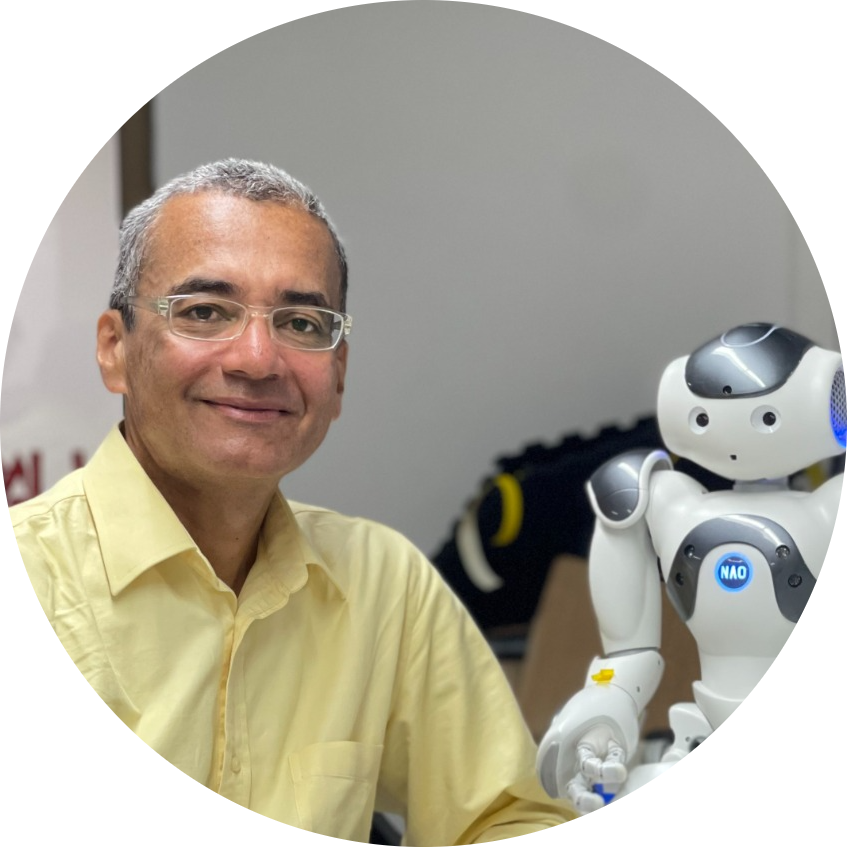
Jesús Alfonso López Born in Cali, Colombia, he is an Electrical Engineer with a Master’s degree in Automation and a PhD in Engineering.
He has over 25 years of experience in teaching and developing projects related to Artificial Intelligence. His areas of interest include artificial neural networks and deep learning, edge AI, AI education, and the potential impact of this technology on society.
He is a Senior Researcher in the Colombian National Science, Technology, and Innovation System (SNI) of the Ministry of Science, Technology, and Innovation (MinCiencias). He is a Senior Professional Member of the IEEE, where he belongs to the Colombian chapter of the Society for Computational Intelligence. He also belongs to the AIEng4D Academic Network (formerly TinyML4D), an initiative that brings AI engineering education to universities in Latin America, Africa, and Asia.
He is currently affiliated with the Universidad Autónoma de Occidente in Cali, Colombia.
He has published numerous articles, book chapters, and books on Artificial Neural Networks, Deep Learning, and other artificial intelligence techniques. Among his intellectual output, his textbook, Deep Learning, Theory and Applications, stands out and is used as reference material in different higher education centers.